Who Did Jesus Actually Claim to Be?
Jesus did not claim to be merely a teacher. Through His words and actions, He claimed divine authority that demands a response.

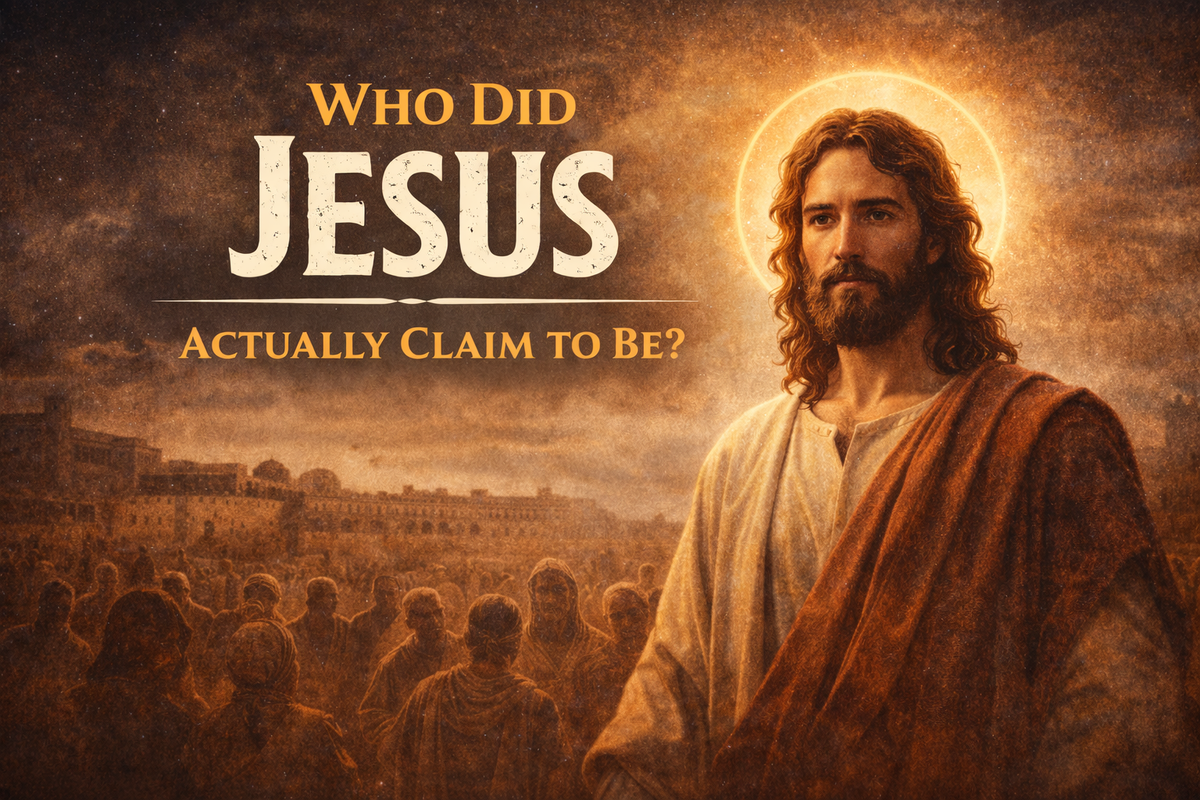
Watch the Short:
https://www.youtube.com/shorts/k38dGAvrCi4
Few questions are more important—or more misunderstood—than this one:
Who did Jesus actually claim to be?
Many people today assume Jesus never claimed anything extraordinary about Himself. According to popular opinion, He was a moral teacher, a spiritual guide, or a social reformer whose followers later exaggerated His identity. The idea that Jesus claimed to be God, some say, was a legend that developed over time.
But when the Gospels are read carefully, that explanation does not survive.
Jesus did not leave His identity vague. He did not allow Himself to be remembered merely as a teacher. Again and again, through words and actions, He made claims that forced people to confront a far more serious conclusion.
Jesus Didn’t Speak Like a Mere Teacher
Religious teachers typically point away from themselves and toward God. Prophets say, “Thus says the Lord.” Rabbis appeal to earlier authorities.
Jesus spoke differently.
He did not say, “God says.”
He said, “I say to you.”
In the Sermon on the Mount, Jesus repeatedly contrasted His own authority with the Law itself: “You have heard that it was said… but I say to you.” This was not commentary. It was command.
No faithful Jewish teacher would dare place his own words above the Law of Moses—unless he believed he possessed divine authority.
He Claimed Authority Over Sin
One of the clearest moments occurs when Jesus forgives sins.
To modern readers, this can seem routine. But to His original audience, it was shocking. In Jewish understanding, sin is committed against God. Only God can forgive sin.
When Jesus declared a man’s sins forgiven, the religious leaders immediately understood the implication. They did not accuse Him of poor theology. They accused Him of blasphemy.
Their reasoning was simple:
Either Jesus was God—or He was claiming to be.
Jesus did not correct them.
He Claimed Authority Over the Sabbath
The Sabbath was not a minor religious custom. It was a covenant sign between God and Israel. Yet Jesus boldly declared, “The Son of Man is Lord of the Sabbath.”
That statement carries enormous weight.
To be “Lord” over something instituted by God is to claim authority equal with God. Jesus was not debating Sabbath regulations. He was asserting ownership.
The Sabbath belonged to Him.
He Accepted Worship
Throughout the Gospels, people worship Jesus.
This alone settles the question.
Angels in Scripture refuse worship. Faithful servants of God reject it. Worship belongs to God alone.
Yet Jesus accepts worship—without hesitation, without correction, without qualification.
If Jesus were merely a teacher, accepting worship would have been a grave sin. Instead, the Gospels present it as appropriate.
Jesus behaved as someone who believed worship belonged to Him.
“Before Abraham Was, I Am”
Perhaps the most explicit claim comes in John’s Gospel.
When Jesus said, “Before Abraham was, I am,” He was not making a poetic statement about age. He was invoking the divine name revealed to Moses at the burning bush.
The reaction proves the point.
The crowd picked up stones to kill Him.
They did not misunderstand Him. They understood Him perfectly.
Jesus was identifying Himself with the eternal, self-existent God of Israel.
The Son of Man Claim
Jesus frequently referred to Himself as “the Son of Man.” To modern ears, this can sound humble or vague. To a first-century Jewish audience, it was anything but.
The title comes from Daniel 7, where the Son of Man is a heavenly figure who receives eternal authority, worship, and dominion from God Himself.
When Jesus applied this title to Himself—especially in contexts involving judgment and glory—He was claiming a role reserved for God.
At His trial, when asked directly if He was the Messiah, Jesus answered by quoting Daniel and Psalms, declaring that He would sit at the right hand of Power and come on the clouds of heaven.
The response was immediate.
The high priest tore his garments.
The verdict: blasphemy.
His Enemies Understood His Claims
One of the strongest evidences comes not from Jesus’ followers, but from His enemies.
Again and again, religious leaders accused Jesus of making Himself equal with God. They sought to kill Him not for teaching kindness or morality, but for claiming divine authority.
If Jesus had not made these claims, the accusations would make no sense.
His enemies heard Him clearly.
The Resurrection Confirms the Claims
Jesus’ claims alone would be extraordinary—but Christianity does not rest on claims alone.
It rests on the resurrection.
Jesus predicted His death.
He predicted His resurrection.
And His tomb was found empty.
The resurrection functions as God’s public confirmation of Jesus’ identity. It is God’s answer to the question Jesus forced people to ask.
If Jesus rose from the dead, His claims were true.
Not a Legend, Not a Later Invention
Some argue that Jesus’ divinity was a later invention by His followers. But the earliest Christian writings already present Jesus as divine. Worship of Jesus appears immediately. Prayers are offered in His name. Baptism is commanded in His authority.
There is no slow evolution from teacher to God.
The identity of Jesus is present from the beginning.
The Question Still Stands
Jesus did not allow neutrality.
He did not leave space for admiration without commitment. His claims force a decision. As C.S. Lewis famously observed, Jesus must be one of three things:
- A liar
- A lunatic
- Or Lord
There is no category for “mere teacher.”
Final Reflection
Jesus did not claim to be one path among many. He claimed to be the way. He did not claim to reveal truth. He claimed to be the truth.
That is why His identity still divides history—and demands an answer from every generation.
The real question is not only who Jesus claimed to be.
It is whether we will take Him at His word.